Cost of Service and Rate Study
INFORMATION ON PROPOSED SEWER RATES
Every five years, the Fairfield-Suisun Sewer District works with an independent rate consultant to complete a Cost of Service and Rate Study. This study reviews and analyzes the District’s historical and budgeted operating costs, planned multi-year capital projects, outstanding debt service obligations, financial plans and policies, and operating and capital reserve targets to determine sewer rates that support reliable service and long-term financial sustainability.
Proposed 5-Year Rate Schedule

2025 Sewer Rate and Capacity Charge Study
The results of the Cost of Service and Rate Study and presentation to the Board of Directors are available for review in the PDFs below.
Proposition 218 - Notice of Public Hearing
Proposition 218, or the “Right to Vote on Taxes Act (Act)”, was approved by California state voters in November 1996. The Act amended the California constitution to require local governments to follow certain procedures when they impose fees of certain kinds of services in order to ensure that they are subject to voter approval. Proposition 218 is a tool designed to provide greater public involvement in the rate-setting process.
More information on how the owner or a tenant receiving sewer service on a parcel can submit a protest, objection, or can request more information can be found in the Proposition 218 Notices below, as well as the section on this page titled “Participate in the Process.”
Proposition 218 Notices
Proposition 218 Notices were mailed to parcel owners in accordance with California requirements. Translated versions of the Notice are available below.
Public Hearing Date
Monday, April 27, 2026 at 6:00pm or soon thereafter as the matter is reached on the agend.
WHERE: District Board Room
1010 Chadbourne Rd, Fairfield, CA 94534
Participate in the Process
Under California law, customers may oppose the proposed rate adjustment by submitting a protest, or may submit an objection stating specific grounds for claiming the sewer rates do not comply with Proposition 218.
A protest is a straightforward way to oppose the sewer rate adjustment – it does not require any specific reason for the protest.
An objection is a legal option to oppose the rate adjustment – it requires stating the specific grounds for claiming the District has not complied with Proposition 218.
Protests and objections have specific requirements for what must be included. Details on the exact requirements for protests and objections can be found in the drop down menus below.
Submit an Objection to the Sewer Rates
Deadline for Submitting an Objection
Written legal objections must be submitted no later than 5:00 PM on March 26, 2026.
(Please note the date for written legal objections is EARLIER than the deadline for protests.)
Requirements for an Objection
To be considered timely and valid, a written legal objection must:
- Be in writing with an original signature from the property owner OR the tenant responsible for paying the sewer bill (the account holder).
- Identify the parcel for which the legal objection is filed, by street address OR the Assessor’s Parcel Number (APN).
- Clearly state that the communication is a “written objection.”
- Describe the basis for the objection with sufficient specificity to allow the District to respond in writing.***
- Include the desired resolution or outcome.
- Be received by the District by no later than 5:00 p.m., on March 26, 2026.
***Important note: A statement such as “these rates violate Proposition 218”, without supporting explanation, is not sufficient. The objection should, where possible, cite the specific constitutional provision, statute, or regulation believed to be violated (for example, “California Const., art. XIII D, § 6(b)(3)” or “Gov. Code § 53755”).
Where to Send an Objection
Mail to:
Director of Administrative Services
Fairfield-Suisun Sewer District
1010 Chadbourne Road, Fairfield, CA 94534
Email to:
Scanned copies of written legal objections containing all required items above including the original signature, may be emailed to contactus@fairfieldsuisunsewer.ca.gov. Fax will not be accepted.
What to Expect from an Objection
At the April 27, 2026 public hearing, the District Board will consider all timely written legal objections and the District’s written responses. The District’s responses will explain the substantive basis for retaining or modifying the proposed sewer rates in response to written objections, including the reasons for rejecting any requested changes.
Be advised that pursuant to Government Code section 53759(d) there is a 120-day statute of limitation for any challenge to the new, increased or extended fee or charge.
Template for an Objection
Submit a Protest to the Sewer Rates
Deadline for Submitting a Protest
Written protests must be received by the District not later than the close of the public hearing which will begin at 6:00 PM on April 27, 2026. Only one protest per parcel will be counted.
Who May Submit a Protest
- The property (parcel) owner, OR
- A tenant who is the sewer utility account holder and is responsible for paying the sewer bill
If the person signing the protest owns the property but is not listed as the owner on the most recent Solano County assessment roll, the protest must include written proof of current ownership.
Requirements for a Protest
All Protests Must
- Be in writing with an original signature from the property owner OR the tenant responsible for paying the sewer bill (the account holder).
- Identify the parcel by street address OR the Assessor’s Parcel Number (APN).
- Clearly state that you oppose the proposed sewer rates (no specific reason has to be provided).
- Be received by the District at or before the close of the public hearing, which will begin at 6:00 PM on April 27, 2026.
Where to Send a Protest
Mail to:
Director of Administrative Services
Fairfield-Suisun Sewer District
1010 Chadbourne Road, Fairfield, CA 94534
Email to:
Scanned copies of written legal objections containing all required items above including the original signature, may be emailed to contactus@fairfieldsuisunsewer.ca.gov. Fax will not be accepted.
What to Expect from a Protest
Protests will be tallied at the public hearing on April 27, 2026. If the District receives valid written protests from a majority of the parcels that receive sewer service, the proposed sewer rate increases will not be adopted.
Template for a Protest
Request Additional Information and Details
The Fairfield-Suisun Sewer District believes in public transparency and open communication. If you would like to request more information or discuss information presented on this page, please send a request to contactus@FairfieldSuisunSewer.ca.gov.
So we can follow up on your request, please include:
- Your Name
- Phone
Frequently Asked Questions:
What is a Cost of Service and Rate Study and why was it done?
A Cost of Service and Rate Study was last conducted in 2022 and established Sewer Service Charges through June 30, 2027. A Cost of Service and Rate Study looks at how much it costs to operate, maintain, and improve the sewer system over time. The study reviews historical and budgeted operating costs, planned multi-year capital projects, outstanding debt service obligations, financial plans and policies, and operating and capital reserve targets.
This information is used to set sewer rates that provide enough revenue to safely and reliably operate the system in the long-term.
How was the Cost of Service and Rate Study conducted, and who was involved?
The Cost of Service and Rate Study was completed by an independent rate consultant, Hildebrand, LLC. Hildebrand LLC prepared a multi-year financial plan and cost of service analysis to:
-
Develop a multi-year financial plan showing how the District will fund day-to-day operations and major capital projects over time.
-
Recommend annual adjustments to Sewer Service Charges to ensure sufficient revenue to meet ongoing operational and financial obligations.
-
Analyze the cost of providing sewer service using fair, consistent, and industry-accepted cost of service methodologies.
-
Recommend updates to the District’s rate structure to ensure costs are recovered equitably and in compliance with industry standards and applicable California law.
-
Update Sewer Capacity Charges (connection fees) to ensure new development pays its fair share for the sewer infrastructure that will serve it.
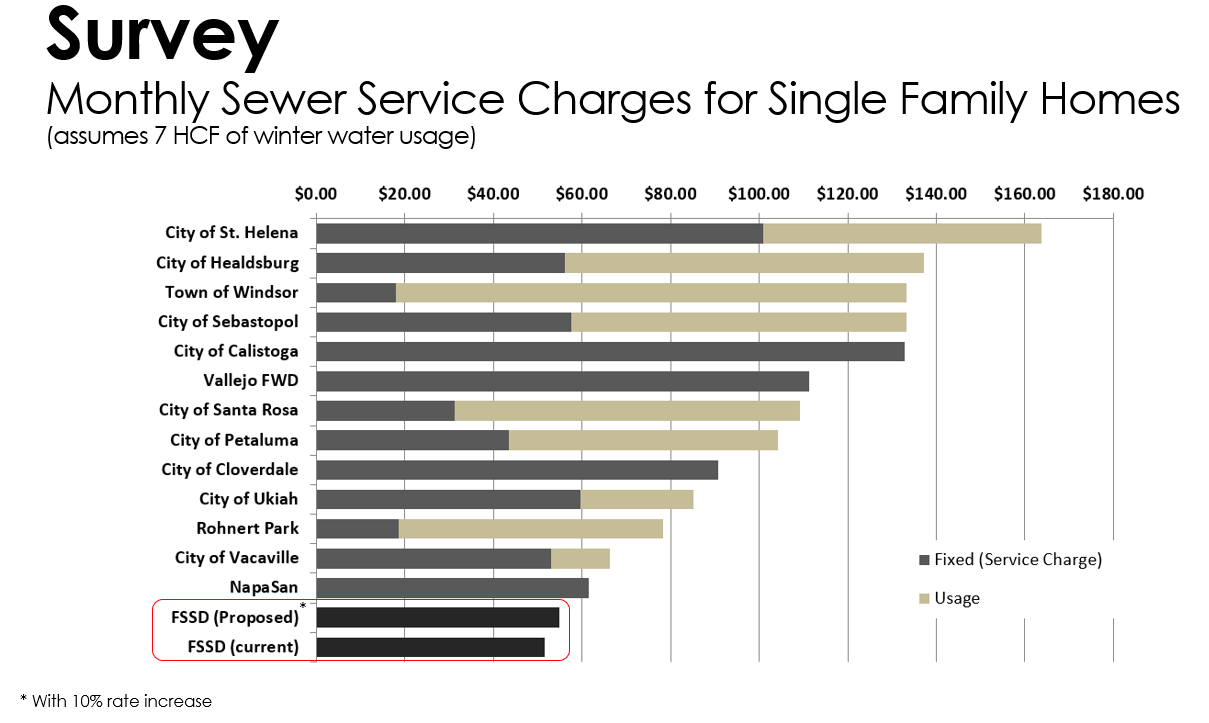
How do Fairfield-Suisun Sewer District rates compare to surrounding agencies?
The District’s goal is not to have the lowest rate compared to neighboring agencies. The District’s goal is to have the lowest responsible sewer rate in order to efficiently and effectively operate and maintain the system to protect public health and the environment.
See the survey below from the 2025 Cost of Service and Rate Study for a comparison of the District’s (FSSD) current and proposed rate compared to surrounding agencies.
How much wastewater does the average residential household produce per day, and how much does it cost to treat?
The average residential household produces approximately 178.3 gallons per day of wastewater. This includes water from showers, toilets, laundry, dishwashers, sinks, and general cleaning.
178.3 gallons per day is roughly equal to:
- Two full bathtubs of water per day, or
- Three standard 55-gallon drums
At the proposed residential rate starting July 1, 2026 ($54.91 per month), the cost to treat this wastewater is about $1.81 per day.
($54.91 x 12 months) / 365 days
How does the Anheuser Busch closure impact the Cost of Service and Rate Study?
Anheuser Busch has been a significant industrial customer for the District. The Cost of Service and Rate Study was completed in November 2025, before Anheuser Busch provided the community with their closure notice.
Anheuser Busch is a significant industrial customer for the District. The District treats approximately 153.9 million gallons of wastewater per year from Anheuser Busch with annual sewer revenues of approximately $1.2 million.
The District is not revising the Cost of Service and Rate Study at this time. Instead, the District will manage the impacts through the annual budget process and long-term financial planning, including continued review of its ten year Capital Improvement Program to determine whether future projects should be delayed or rescheduled.
What are “customer classes” and why are they different?
The District serves a population of approximately 150,000 residents of the City of Fairfield and City of Suisun City, with approximately 39,000 sewer accounts made up of residential, commercial, and commercial / industrial case-by-case customers.
Different customer types place different demands on the sewer system based on how much wastewater they produce and how strong that wastewater is. The study analyzed billing data and wastewater characteristics to assign costs fairly. As a result, each customer class pays rates based on its share of system use.
What do sewer rates pay for?
Rates fund:
- Treatment plant operations
- Sewer pipe maintenance and replacement
- Regulatory compliance
- Emergency response
- Long-term investment in nearly $1 billion of aging infrastructure, much of which is 50+ years old
- Required operating and capital reserves to ensure financial stability and system reliability
Why are sewer rate increases proposed to change?
Sewer rate increases are proposed to:
- Maintain and replace aging infrastructure
- Meet existing and new regulatory requirements
- Address rising cost pressures for energy, chemicals, construction, and labor
- Fund the District’s long-term Capital Improvement Program
- Ensure long-term system reliability for a critical 24/7 service
Are sewer rate revenues restricted?
Yes. Revenues from sewer rates are legally restricted and may only be used for wastewater-related purposes, consistent with California law.
When will the new sewer rates be effective?
If there is no majority protest or valid legal objection to the rates, the new sewer rates will go into effect for all residents and business customers on July 1, 2026. This will replace the final year of the currently-adopted five-year rate schedule.
What is a majority protest under Proposition 218?
A majority protest occurs when more than 50% of affected parcels submit valid written protests opposing the proposed rates. If a majority protest exists, the rates cannot be adopted.
A protest is different than an objection. For more information, refer to the Participate in the Process section.
Does speaking at the public hearing count as a protest?
No. Oral comments do not count as protests unless they are submitted in writing and meet the legal requirements for a Proposition 218 protest.
For more information, see the Participate in the Process section, including a sample protest letter.
Can I submit both a written objection and a protest?
Yes. Submitting a written objection does not replace or count as a Proposition 218 protest. Each process serves a different legal purpose, and customers are allowed under California law to submit one or both.
How does the District minimize rate impacts?
The District manages it’s costs by:
- Finding energy-saving solutions – the District’s new cogeneration engine is anticipated to save ~$1.0 million per year in electricity costs.
- Conducting preventative maintenance – Preventative maintenance helps maintain the system and reduce costly emergency repairs.
- Creating an efficient Capital Improvement Program – bundling capital projects together can save costs and create efficiencies in completing projects.
- Looking for rate equity with projects – while the District prefers to use reserves rather than debt, some projects are so large and long-lasting that funding them entirely upfront would unfairly burden current customers. In those cases, financing costs over time helps ensure equitable cost-sharing across generations of ratepayers.
What assistance programs are available?
The District is primarily funded by sewer rate revenue. Under Proposition 218, sewer rates must be based on the cost of providing service and cannot be used to subsidize one customer class over another. As a result, the District cannot offer discounted sewer rates for low-income, senior, or disabled customers.
Many agencies fund assistance programs through General Fund revenues, such as property tax, which are not subject to Proposition 218 restrictions. Because the District does not receive property tax revenue, it is unable to offer bill assistance programs for sewer service.
Although the District cannot directly provide financial assistance using sewer rate revenues, other resources may be available to Fairfield and Suisun City residents through regional or county programs for non-sewer services, including:
- City of Fairfield Low Income Senior/Disabled Water Refund – Applications are accepted January 1, 2026 through March 31, 2026.
- Solano County CalWORKs – CalWORKs is a public assistance program that provides cash aid and services to eligible families that have a child(ren) in the home. If a family has little or no cash and needs housing, food, utilities, clothing or medical care, they may be eligible to receive immediate short-term help. Families that apply and qualify for ongoing assistance receive money each month to help pay for housing, food and other necessary expenses.
- Solano County Utility Resources – An overview of resources available in Solano County for general assistance, internet, PG&E discount and payment assistance, and medical equipment resources.